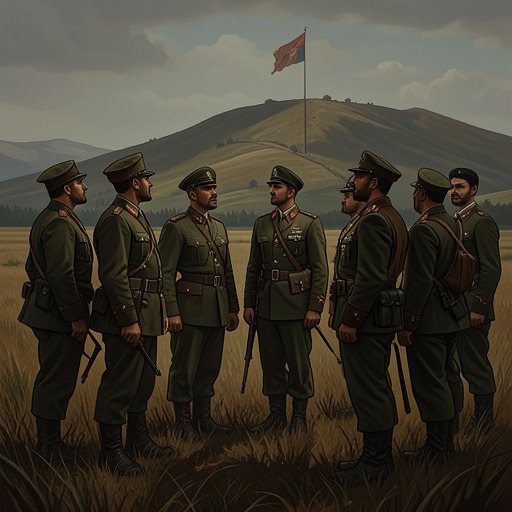
Benbili revolutionaries
The DispossessedBenbili revolutionaries are the insurgents who capture the capital of Benbili and open its jails, making their revolt a distant but urgent sign of possibility for Shevek. Their uprising also exposes the imbalance between a largely unarmed popular movement and the military power A-Io sends to restore the displaced government.
Revolt and Its First Victories
News of revolution reaches Shevek in emphatic headlines announcing that rebels hold the capital. Reports describe a country that is formally a parliamentary democracy but in practice a military dictatorship run by generals. The insurgents take Meskti, the capital, while General Havevert escapes in his armored airplane. Some lesser generals are captured and subjected to emasculation, a punishment described as traditional in Benbili rather than execution. As the army retreats, it burns fields and towns; guerrilla partisans harry it.
The revolutionaries’ opening of the jails is a decisive act as well as a military success: they grant amnesty to all prisoners. Shevek’s heart leaps at the report. The act makes the revolt signify more to him than a change of rulers; it offers hope that the consequences of political upheaval might include release from confinement. That response echoes the children’s earlier encounter with the idea of prison through the story of Odo’s imprisonment in Drio: the institution is presented as a place where a State locks up people who disobey its laws, and the children recoil at the notion that many people might beat one person. The novel thus places the rebels’ opening of the jails against a political world in which punishment and state force are familiar instruments.
Unequal Forces and Foreign Intervention
The rebels are mostly not even armed. Their victories therefore stand in stark contrast to the force available to A-Io: guns, armored cars, airplanes, and bombs. Shevek reads about this equipment and feels sick. On the fourth day of the revolt, he watches a debate in the Council of World Governments and hears the Ioti ambassador announce that A-Io is sending armed reinforcements to President-General Havevert, presenting the intervention as support for Benbili’s democratic government. The news makes the insurgents’ precarious position unmistakable: the government they have challenged can draw on an outside power’s vastly superior military resources.
Shevek has nobody among his immediate associates with whom he can freely discuss his anger. Saio Pae is out of the question, Atro is an ardent militarist, and Oiie’s attachment to property and law and order leads him to reject Shevek’s anarchist reading of the revolt. Oiie describes the conflict as part of the power struggle between A-Io and Thu, arguing that the question of who governs Benbili matters less than the rivalry between those states. He also claims that freedom without guns cannot survive an aggressive rival. Shevek repeats Oiie’s phrase, “The politics of reality,” and calls it a curious expression for a physicist. The exchange sets the rebels’ struggle for freedom against a geopolitical account that treats their country chiefly as terrain in a contest between powers.
Significance in the Novel
The Benbili revolutionaries’ position sharpens the novel’s contrast between freedom as a social ideal and freedom as a condition exposed to force. Their actions—seizing the capital, resisting the retreating army, and freeing prisoners—give concrete form to the hope that Shevek sees in revolution. A-Io’s intervention, and the rebels’ lack of arms, show how that hope can be endangered by military power exercised in the name of restoring democracy.
The episode also resonates with Anarres’s own institutional tensions. Its dispersed settlements depend on transport and resource coordination, while the administrative computers and central federatives are located in Abbenay; the settlers recognize centralization as a continuing danger requiring vigilance. Later, when a Syndicate of Initiative proposes bringing Urrasti to Anarres, opponents warn that contact might lead from visitors to profiteers and eventually an occupying force. Shevek answers that his proposed journey to Urras tests the individual’s right to act harmlessly to others, and argues that the society came to Anarres for freedom, not safety. The revolutionaries in Benbili supply the harsher counterpart to that debate: a people can make a bid for freedom, but the act does not shield them from the military calculations of stronger states.